












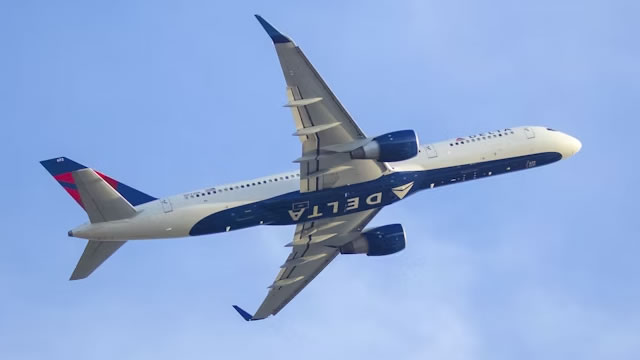
Why Is Delta (DAL) Up 23.3% Since Last Earnings Report?
Delta (DAL) reported earnings 30 days ago. What's next for the stock?
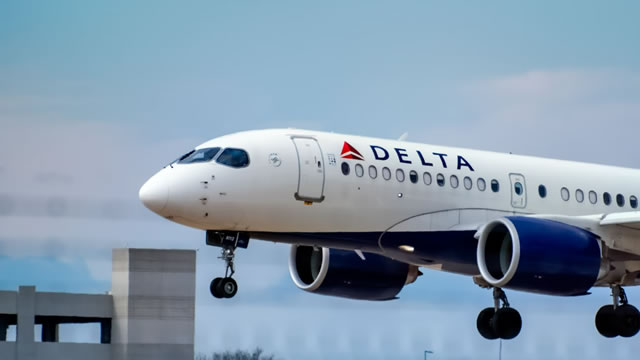
How Should You Play DAL Stock Post Scandinavian Expansion Update?
With DAL stock gaining recently, we assess its investment worthiness at current levels.
Delta Air Lines: Significant Upside With First Class Fundamentals And A Discounted Price
Delta Air Lines is presenting a 50% appreciation opportunity by 2026 due to their operational and strategic execution. Delta's strategic initiatives include debt reduction, investing in profitable hubs, and optimizing fleet usage, aiming for normalized 9-10% profit margins by 2028. A covered straddle trade offers a potential 189% return in less than 2 years, with a breakeven point of 11% below today's price.

What The Delta Air Lines $1 Billion Share Repurchase Means
Delta Air Lines announced a $1 billion share repurchase program, but it doesn't significantly impact the price target. The share repurchase makes sense given Delta's current EV/EBITDA multiple and projected earnings, but it's not happening at a significant discount. The repurchase reduces outstanding shares by 3.8% with minimal impact on fundamentally supported stock prices.

DAL vs. UAL: Which Airline Stock is a Stronger Play Now?
Amid the tariff-induced decline in domestic air travel demand, let's see which heavyweight, DAL or UAL, is a better pick now.

Final Trade: DAL, WNS, TXN, NKE
The final trades of the day with CNBC's Melissa Lee and the Fast Money traders.

These Were the 2 Worst-Performing Stocks in the S&P 500 in March 2025
March wasn't the best month for the S&P 500, with the index dropping 5.8%. It was a tough month all around, as 98 of the S&P 500 stocks finished the month down at least 10%, but two especially had a bad month: Delta Air Lines (DAL -0.29%) and United Airlines (UAL 0.36%).
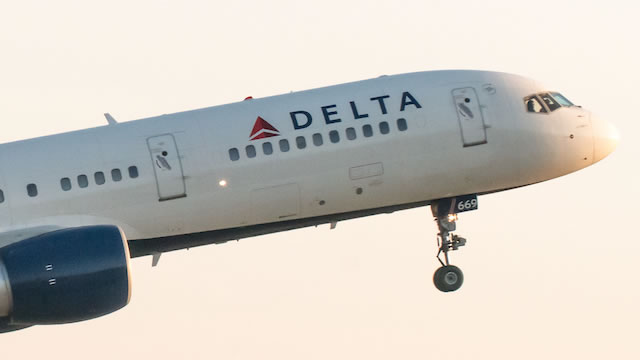
Delta Air Lines: This Phoenix Can Rise From the Ashes
The underlying cause of the price crash is the maximum uncertainty linked to Trump's tariff agenda and the trade war it caused. But investors should note that Delta's business remains firm, and the company is rebuilding shareholder value quickly.

How Should You Play DAL Stock Post Q1 Earnings and Revenue Beat?
Given the tariff-induced uncertainty, we assess DAL stock's investment worthiness at the current levels.
Delta Air Lines Has Tools Necessary To Weather Macro Storm, But It Remains Unattractive
DAL had a strong Q1, beating top- and bottom-line estimates, but pulled full-year guidance due to economic uncertainty and tariff unpredictability. Despite a 32% stock decline, DAL's diversified revenue streams and high-income customer base should help it to weather economic turbulence. The airline plans to reduce capacity growth in H2 and aggressively manage costs, aiming to remain profitable and generate strong free cash flow.
Delta Air Lines: Stock Surges After Q1 Earnings Despite Guidance Drop
Delta Air Lines' stock has faced significant pressure due to trade turmoil and eroded consumer confidence, impacting bookings and revenue growth. Despite challenges, Delta exceeded expectations in Q1, driven by strong performance in the Atlantic and Pacific markets and effective capacity management. The company has lowered its 2025 outlook due to macroeconomic uncertainties, with revised EBITDA and free cash flow estimates reflecting the ongoing market turmoil.
Will Delta Air Lines (DAL) Stock Keep Flying After Beating Q1 Expectations?
Able to exceed its Q1 expectations on Wednesday, Delta Air Lines (DAL) stock got a further boost as President Trump's decision to temporarily rescind reciprocal tariffs sent markets soaring.



