



Procter & Gamble Co. (PG)








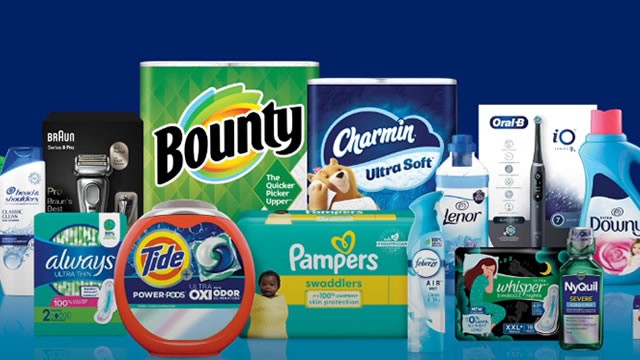
Procter & Gamble tops estimates on resilient demand for beauty, hair care products
Procter & Gamble on Friday beat Wall Street estimates for first-quarter revenue and profit, helped by strong demand for its beauty and hair-care products amid higher prices and a broader slowdown in spending due to economic uncertainties.

Brokers Suggest Investing in P&G (PG): Read This Before Placing a Bet
Investors often turn to recommendations made by Wall Street analysts before making a Buy, Sell, or Hold decision about a stock. While media reports about rating changes by these brokerage-firm employed (or sell-side) analysts often affect a stock's price, do they really matter?

Is Procter & Gamble Worth Pursuing Ahead Of Its Q1 Earnings?
Procter & Gamble has underperformed the S&P 500 and the staple peers from the benchmark, but there's potential for it to make up for lost time. PG will now report Q1 earnings on the 24th of October, where expectations appear to be on the lower side. PG is still expected to facilitate above average market growth, while it is also taking out costs at a rapid pace, and revamping the cost base during the down cycle.
Procter & Gamble Eyes Gains Amid Tariff Turmoil: Can It Deliver?
PG ends fiscal 2025 strong with broad-based growth and innovation, but faces a $1B tariff hit that can test its 2026 momentum.

Procter & Gamble (PG) Stock Falls Amid Market Uptick: What Investors Need to Know
In the most recent trading session, Procter & Gamble (PG) closed at $157.35, indicating a -1.32% shift from the previous trading day.
The Procter & Gamble Company (PG) Presents At Barclays 18th Annual Global Consumer Staples Conference 2025 Transcript
The Procter & Gamble Company (NYSE:PG ) Barclays 18th Annual Global Consumer Staples Conference 2025 September 4, 2025 8:15 AM EDT Company Participants Andre Schulten - Chief Financial Officer Jon Moeller - President, CEO & Chairman of the Board Conference Call Participants Lauren Lieberman - Barclays Bank PLC, Research Division Presentation Operator P&G would like to remind you that today's discussion will include a number of forward-looking statements. If you will refer to P&G's most recent 10-K, 10-Q and 8-K reports, you will see a discussion of factors that could cause the company's actual results to differ materially from these projections.
P&G (PG) Is Considered a Good Investment by Brokers: Is That True?
Investors often turn to recommendations made by Wall Street analysts before making a Buy, Sell, or Hold decision about a stock. While media reports about rating changes by these brokerage-firm employed (or sell-side) analysts often affect a stock's price, do they really matter?
Procter & Gamble: Resilient Business Facing Growth Headwinds
Procter & Gamble remains a hold for me, with a $165 price target, due to revenue stagnation despite its strong dividend history. The 68-year streak of dividend growth and a 2.69% yield make PG attractive for income-focused, risk-averse investors seeking steady quarterly payouts. PG trades at a premium valuation, justified by its high-quality, defensive business model, but overvaluation risks persist if growth doesn't re-accelerate.

Procter & Gamble: A Diaper Of A Deal At This Price
Procter & Gamble's growth has slowed, with weak cash flow and operational metrics not matching its earnings and sales performance. Despite its defensive profile and dividend history, current valuation multiples are too high given the lack of meaningful growth re-acceleration. My DCF analysis suggests a 32% downside to fair value, with current prices only justified by unrealistic 10% growth assumptions.

Here's Why Procter & Gamble (PG) Fell More Than Broader Market
In the closing of the recent trading day, Procter & Gamble (PG) stood at $156.15, denoting a -1.59% move from the preceding trading day.
Procter & Gamble Exhibits High P/E: A Buy Opportunity or Time to Wait?
PG posts solid growth and dividend strength, but its high valuation sparks debate on whether the stock is worth buying now.
Here is What to Know Beyond Why Procter & Gamble Company (The) (PG) is a Trending Stock
Zacks.com users have recently been watching P&G (PG) quite a bit. Thus, it is worth knowing the facts that could determine the stock's prospects.



