



Salesforce Inc (CRM)













Salesforce stock falls service outage hits during crucial conference
Salesforce stock CRM fell 2% on Tuesday as the company's annual Dreamforce conference got underway in San Francisco. The shares came under renewed attention on Wednesday after Salesforce suffered a widespread service outage that left customers unable to access parts of its cloud software suite.

Salesforce CEO Marc Benioff joins growing chorus of tech leaders warning about AI risks
Salesforce CEO Marc Benioff joined the growing debate over AI safety, warning the industry to act responsibly as increasingly powerful models are developed. Benioff pointed to the harms caused by social media as a cautionary tale, saying AI companies should avoid repeating the same mistakes.
Here's How Much Traders See Salesforce Stock Moving After ‘Dreamforce' Event
Salesforce is set to hold its annual Dreamforce keynote later this afternoon, with traders anticipating a sizable move in the enterprise software giant's stock.
Salesforce: Its AI Distribution Advantage Could Restart Growth
Salesforce leverages its deep enterprise footprint to accelerate AI adoption, aiming to boost wallet share and drive organic growth. CRM's AI layer is scaling rapidly, with Agentforce ARR up 240%+ and strong sequential growth in agentic work units and premium bookings. Valuation remains reasonable at a 14.88x forward P/E, with base case upside to $285–$315 if AI monetization and organic growth materialize.

Salesforce and Nvidia's new reasoning model is everything the AI labs should fear
A new AI model called Koa is one of the biggest announcements from Salesforce this week at its giant Dreamforce tech conference. Koa is the company's first reasoning model, built on Nvidia's open-weight Nemotron model.

Salesforce Stock Running into Trouble on the Charts
Subscribers to Schaeffer's Weekend Trader options recommendation service received this CRM commentary on Sunday night, along with a detailed options trade recommendation -- including complete entry and exit parameters.

Salesforce, Inc. (CRM) Is a Trending Stock: Facts to Know Before Betting on It
Salesforce (CRM) has received quite a bit of attention from Zacks.com users lately. Therefore, it is wise to be aware of the facts that can impact the stock's prospects.

Salesforce Just Gained 23% in a Month: Take Profits, or Buy More?
Shares of Salesforce (NYSE:CRM | CRM Price Prediction) are trading at $242.40 Thursday afternoon, down 0.7% for the session but up 23% over the past month.
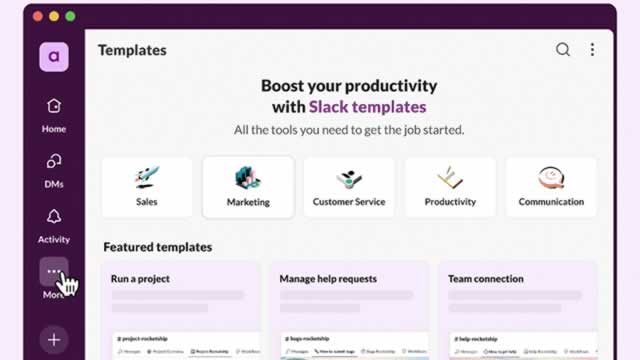
Salesforce Just Gave Investors a Reason to Rethink This Beaten-Down Stock
Salesforce spent most of 2026 getting crushed by fears that AI would kill its business model, and then one earnings report flipped the entire narrative.
Salesforce, Inc. (CRM) Presents at Goldman Sachs Communacopia + Technology Conference 2026 Transcript
Salesforce, Inc. (CRM) Presents at Goldman Sachs Communacopia + Technology Conference 2026 Transcript

Salesforce Sees AI Agents Transforming Slack and Driving Premium Growth
Salesforce NYSE: CRM executives outlined the company's approach to AI partnerships, Slack monetization and premium product adoption during a Goldman Sachs Communacopia session, emphasizing the role of agents in expanding how customers use its software.
AI research startup Listen Labs scrubbed a $1.5B funding round for Salesforce talks
Listen Labs, a market research startup that uses voice AI to conduct customer interviews, recently signed a term sheet for a $125 million Series C at a $1.5 billion valuation, with Menlo Ventures set to lead the round, according to several people with knowledge of the matter.




