



Advanced Micro Devices Inc. (AMD)














AMD: I Am Buying The Dip With Confidence
AMD: I Am Buying The Dip With Confidence
AMD: OpenAI's Deep Research Hints At Explosive Growth Potential
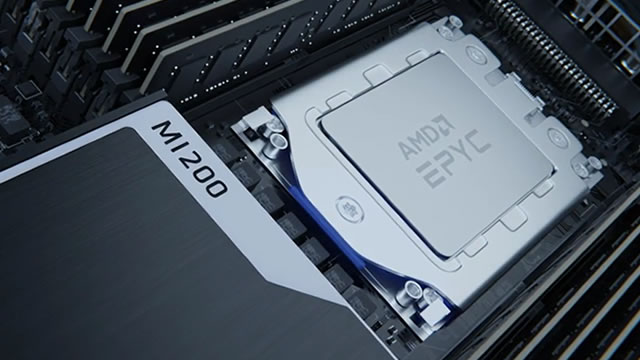
AMD continues to show strong momentum in the high-performance computing and AI markets. The arrival of OpenAI's Deep Research is a sign that highly inference-intensive AI Agents are ready for prime time. AMD's high-memory Instinct GPUs and EPYC CPUs give the company a competitive edge by reducing latency and operational costs.

4 No-Brainer AI Chip Stocks to Buy Right Now
Spending on artificial intelligence (AI) infrastructure is set to see a big boost this year, which will undoubtedly help a number of semiconductor stocks with ties to AI chips.
Roundtable: If I Could Only Own 1 Artificial Intelligence (AI) Stock, This Would Be It
Investing, especially in the artificial intelligence (AI) field, is fraught with uncertainty. Some stocks have returned 1,000% or more in a relatively short time, while others with potentially promising growth prospects ended up losing money for investors.
Should You Buy the Dip on AMD's Stock Down 50% From Its All-Time High?
History seems to be repeating itself for Advanced Micro Devices (AMD -2.92%). In the early 2000s, it was said that Intel let AMD survive only so that Intel wouldn't be considered a monopoly in the PC processor market.

Better Artificial Intelligence Stock: AMD vs. Nvidia
Artificial intelligence (AI) has been a hot sector to invest in, helping the stock market reach new highs in 2024. Two of the biggest beneficiaries from the rise of AI are semiconductor giants Advanced Micro Devices (AMD -2.92%) and its chief rival Nvidia (NVDA -4.05%).

The #1 AI Investment Might Be This $3 Company You’ve Never Heard Of
Millionaire Venture Capitalist and tech analyst, Luke Lango, is no stranger to uncovering little-known stocks on the verge of huge run ups… Lango called the rise of AMD, GameStop and Blink while they were all trading under $2. So while most of the world fixates on the rollercoaster swings of A.I. stocks like Nvidia, Google and Microsoft… Luke Lango says you have to look beyond the headlines to see the real AI wealth creation story taking shape… And he claims its centered around a tiny $3 AI stock at the heart of a $100 Trillion wealth shift. It’s a startup he says could soon be “The Amazon of Real Estate.” As its proprietary AI technology revolutionizes how virtually everyone buys and sells their home, Luke believes this small startup could soon balloon to a $100 billion company. That kind of growth, Lango projects, could send the stock price soaring by as much as 1,000% in the coming year. In a brand new streaming video, Luke Lango travels straight to the Silicon Valley headquarters of this company to reveal why this could be “the biggest wealth-generation opportunity no one is talking about.” Lango says the stock’s share price is not likely to stay low for long, due to the enormous buzz it’s generating in Silicon Valley. As a Silicon Valley insider himself, Luke decided to “break ranks” and share the name, ticker and details of this company right here — no strings attached. So make sure you have a pen and paper ready to go when he reveals the ticker of his NEXT big 1,000% AI bet. Click Here to Watch the Full Story… With Innovation Investor, Luke Lango’s goal is to offer readers research on an elevated small-cap investing strategy that goes beyond anything that’s been done before on Wall Street. Luke was ranked America’s #1 stock picker in 2020 according to TipRanks and has 15 recommendations that have soared as high as 1,000% or more over his tenure. *All investing includes risk of loss*
Advanced Micro Devices, Inc. (AMD) Is a Trending Stock: Facts to Know Before Betting on It
Recently, Zacks.com users have been paying close attention to Advanced Micro (AMD). This makes it worthwhile to examine what the stock has in store.
Wall Street Is Sleeping On AMD's AI Inference Boom
Wall Street Is Sleeping On AMD's AI Inference Boom

Why I Decided to Buy AMD Stock Despite the Bad Sentiment
In this video, I will cover the recent updates about Advanced Micro Devices (AMD -0.24%). Watch the short video to learn more, consider subscribing, and click the special offer link below.

Better Artificial Intelligence Stock: Nvidia vs. AMD
Discrete GPUs were initially designed for use in video games and professional graphics applications, but they've now become the backbone of data centers that use them to process all sorts of computations, especially those involving complex artificial intelligence (AI) functions. Unlike CPUs, which process a single piece of data at a time through scalar processing, GPUs use vector processing to manage a wide range of floating-point numbers and integers simultaneously.

AMD Before Nvidia's Earnings: Is It The Next Intel?
I see Advanced Micro Devices, Inc. at a crossroads — Is it going to be the Nvidia or the next Intel? I believe Nvidia's Q4 earnings will shed some light on this question. AMD's Q4 earnings show Data Center up 69%, well below Nvidia's Q3 results. AMD is failing to catch up. Yet, I think it is too early to call it quits. My bear case: AI might be a “winner-takes-all” market, leaving AMD with scraps, worsened by its known software issues.




