











The Most Expensive Failed Startups of All Time
In the history of the business world, it should go without saying that far more companies fail than succeed. This is an unfortunate truth, with as many as 20% of new businesses failing in their first year, 50% within 5 years and 65% within 10 years. Only 35% of companies, or around one-third according to the Bureau of Labor Statistics, can celebrate a ten-year mark. Key Points It’s an unfortunate truth that more startups fail than succeed. The hope is that you don’t expand too quickly without ensuring a solid business foundation. Sometimes, ideas are too early to market, as Webvan shows, as grocery delivery is now widespread. 4 million Americans are set to retire this year. If you want to join them, click here now to see if you’re behind, or ahead. It only takes a minute. (Sponsor) The most challenging point for some businesses, especially founders and CEOs, is that their failures are very public. It’s one thing to fail and disappoint yourself and your family, but it’s an entirely different thing to fail on a global scale, let go of employees, and see yourself in headlines worldwide. 10. Pets.com Founded: 1998 Defunct: 2000 Amount lost: $110 million Why it failed: An unsustainable business model based on too high shipping costs The Dot-Com Burst The poster child for the dot-com era going bust, Pets.com was a company born in 1998 and with its massive war chest of startup money, it looked to conquer the pet product delivery market. On the positive side, Pets.com saw an influx of customer activity and orders, but company management spent too much on advertising before the company was bringing in enough revenue. As a result, the company went defunct after just two short years and while it may not be the most expensive failed startup, it’s one of the most memorable. 9. Anki Founded: 2010 Defunct: 2019 Amount lost: $205 million Why it failed: High-profile promise that was unable to meet customer expectations Robots For All The promise of Anki was a welcome one as an American robotics and AI startup that manufactured small robots for children. After receiving over $200 million in investments, the hope was that robots like Cozmo and Vector had emotional intelligence, making them a more ideal play “toy” for children. Unfortunately, the company failed to secure its last round of financing and its only place on the market was a palm-size toy that provided gibberish chitchat with children. 8. Abound Solar Founded: 2007 Defunct: 2012 Amount lost: $614 million Why it failed: Unproven technology and high costs were too much for the solar industry Affordable Solar Panels One of two solar startups to rank among the most expensive failed startups of all time, Abound Solar lost its investors almost $614 million over five years. In an industry where price is everything, Abound Solar didn’t have the right technology or at least reliable enough technology to reduce costs low enough to meet customer demand. Separately, this company should be a lesson on not relying too heavily on government subsidies that don’t help businesses avoid marketplace realities. 7. Webvan Founded: 1996 Defunct: 2001 Amount lost: $800 million Why it failed: Didn’t have the correct scale to match an overly ambitious delivery rollout service Groceries To Your Door The idea of door-to-door grocery delivery is a fantastic one that hits all the right spots today with services like Instacart, Shipt, and Walmart+. However, before these services, Webvan tried out a similar business starting in 1999, but it expanded too fast without building up the right amount of demand. Unfortunately, it spent a ton of money without a solid customer base and profits to sustain its quick growth. In other words, Webvan should have tested demand in a few markets before expanding. 6. Theranos Founded: 2003 Defunct: 2018 Amount invested: $700 million – $1.4 billion Why it failed: Inaccurate and misleading claims about technology Total Fraud Arguably the best-known name on this list, Theranos has become something of the poster-child for failed startups. With hundreds of millions in investments from some of the world’s wealthiest families like the Waltons, Carlos Slim, Betsy Devos, and more, Theranos promised a revolutionary blood-test process. Unfortunately, the technology wasn’t real and the company that was at one time worth $9 billion went up in smoke leaving investors holding the bag on everything and its CEO in jail. 5. Jawbone Founded: 1999 Defunct: 2017 Amount lost: $900 million Why it failed: Failure to properly market and sell its products Not So Wearable Before the Apple Watch helped solidify the wearable market once and for all, Jawbone attempted to do the same thing. Established in 1999, the company was heavily focused on wearables, Bluetooth headphones, and wireless speakers. Venture capitalists poured money into the company, giving it a $3.2 billion evaluation at its peak, but the best Jawbone could manage was only capturing 3% of the market by 2015 before it wound itself down in 2017. 4. Better Place Founded: 2007 Defunct: 2013 Amount lost: $850 – $900 million Why it failed: Mismanagement, increasing infrastructure costs The Pre-Tesla An electric vehicle startup founded by entrepreneur Shai Agassi in 2007, Better Place was poised to look as big, if not bigger, than Tesla. Raising between $850 and $900 million in capital, the company looked to build battery-swapping stations so users could extend the range of their cars. Unfortunately, infrastructure costs were high and the company couldn’t keep operations going indefinitely. 3. Solyndra Founded: 2005 Defunct: 2011 Amount lost: $1.2 billion Why it failed: Could not compete with conventional solar panel manufacturers The Solar Flare Out One of the most heavily promoted startups of all time, Solyndra seemed so promising that even the Obama administration offered them $535 million in loans alongside $1.2 billion in private fundraising. Unfortunately, timing is everything in the startup world, and Solyndra’s timing couldn’t have been worse in 2011, as prices tanked for many of the materials it needed to make its panels. As a result, the company folded and the hope for widespread solar technology along with it. 2. LeSports Founded: 2014 Defunct: 2017 Amount lost: $1.7 billion Why it failed: LeSports faced financial mismanagement while overpaying for broadcasting rights Streaming Failures With an investment of $1.7 billion, LeSports was poised to dominate the Hong Kong sports streaming industry. Backed by a cadre of big investors, the company suffered from poor management and aggressive expansion that left it unable to pay rent on its buildings at one point. The biggest lesson here is to ensure a sustainable revenue model before going to market and not to expand too quickly without ensuring profitability first. 1. Quibi Founded: 2018 Defunct: 2020 Amount lost: $1.75 billion Why it failed: Niche, mobile-only content didn’t resonate with the audience Most Expensive Of All-Time Widely considered the most expensive failed start-up of all time, Quibi couldn’t have been in a better place to succeed. With more than $1.75 billion invested, two massively well-known entertainment and business co-founders, Jeffrey Katzenberg and Meg Whitman, the mobile-only short-form content didn’t resonate with audiences. Quibi was too early to market with 10-minute episodes. Unlike TikTok, which is creator-focused, Quibi was too close to traditional television, which was its ultimate downfall. The post The Most Expensive Failed Startups of All Time appeared first on 24/7 Wall St..

Walmart Faces Heat From Beijing | Full Episode | Insight with Haslinda Amin 3/13/2025
Insight with Haslinda Amin, a daily news program featuring in-depth, high-profile interviews and analysis to give viewers the complete picture on the stories that matter. The show features prominent leaders spanning the worlds of business, finance, politics and culture.

Walmart well-positioned for economic slowdown: Adviser
In the latest Good Buy or Goodbye, Hennion & Walsh CIO Kevin Mahn explains why Walmart (WMT) is a stock worth buying and Kohl's (KSS) is one to skip. To watch more expert insights and analysis on the latest market action, check out more Market Domination here: Click Here #youtube #walmart #stockmarket About Yahoo Finance: Yahoo Finance provides free stock ticker data, up-to-date news, portfolio management resources, comprehensive market data, advanced tools, and more information to help you manage your financial life.

Walmart gets dressing-down from China after pleading with suppliers to absorb tariff costs: report
Chinese officials reportedly warned Walmart of legal consequences during a meeting this week after the retailer pushed Chinese suppliers to bear the brunt of President Trump's tariffs, according to a report.

China reportedly warns Walmart not to shift tariff costs to Chinese suppliers
China's Ministry of Commerce has held talks with Walmart after the U.S. retail giant reportedly requested price cuts from Chinese suppliers to offset tariff costs, a state-backed media outlet said Wednesday.

China Hits Walmart Hard
China's government objects to Walmart Inc.'s (NYSE: WMT) attempt to get China-based suppliers to cut their prices by 10%.
China targets Walmart on tariffs: Here's what to know
CNBC's Eunice Yoon joins 'Squawk Box' with the latest news from Beijing.
China's Commerce Ministry held talks with Walmart after report on price cut demand, state media says
China's Ministry of Commerce has held talks with Walmart as the U.S. retail giant reportedly requested price cuts from Chinese suppliers to offset the tariff costs, a state-backed media outlet said Wednesday. The announcement came after Bloomberg reported last Thursday that Walmart had asked some Chinese suppliers, including makers of kitchenware and clothing, to lower prices by as much as 10% for each round of U.S. tariffs.

China Summons Walmart for Talks as Suppliers Complain Over Tariffs
Beijing has summoned Walmart for reportedly asking Chinese suppliers to swallow the tariff hikes imposed by the Trump administration, marking the latest salvo in the trade spat between the world's two largest economies.
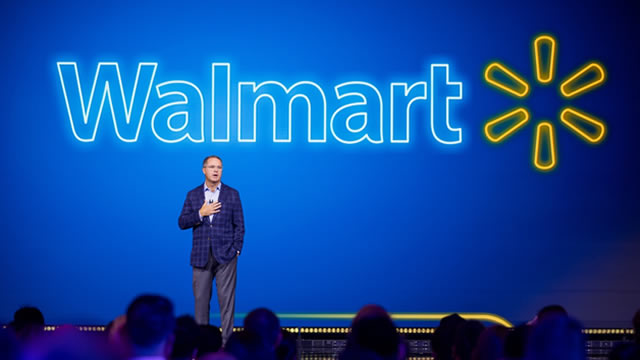
Walmart CEO Says Consumers Changing Spending Due To Inflation, Egg Prices: 'The Money Runs Out Before The Month Is Gone
A leading retailer executive is sending warning signs on consumer spending in the wake of higher egg prices, tariffs and higher inflation.
You May End Up Paying More At Walmart
Walmart (NYSE: WMT) has a big problem. Tariffs of what could be 10% on some Chinese goods imported to the US will increase Walmart’s overall expenses substantially. The king of low priced retail may struggle to keep the title. About three quarters of Walmart’s suppliers are located in China. The world’s largest retailer counts on low cost manufacturing in China to allow it to offer its low retail prices while retaining good margins. Walmart has an expensive problem if tariffs bite. If it raises its merchandise prices customers may cut back spending, or shop elsewhere. Walmart has started to attack the tariff problem, although there is no certainty its plans will allow it to keep merchandise prices at current levels. According to Bloomberg, Walmart may be able to overcome a portions of the challenges. “Some suppliers, including producers of kitchenware and clothing, have been asked to lower their prices by as much as 10% per round of tariffs, essentially shouldering the full cost of Trump’s duties…”, the news service reports. However, another point is that Walmart’s China’s suppliers are already operating on razor thin margins. Walmart’s request may put China suppliers in the red. Walmart operates on thin margins already as well. In the most recent quarter, Walmart had revenue of $180.6 billion, and operation income of $7.9 billion. The operation margin is only 4.3%. The US Walmart margin is slightly better. Revenue was $125.3 billion and operating income of $6.5 billion which is 5.3%. Walmart will not get all of its suppliers to cut prices. That leaves it with a difficult choice. Should it risk charging higher prices and potentially losing customers? Or, should it keep prices the same and risk lower operating margins? The post You May End Up Paying More At Walmart appeared first on 24/7 Wall St..
Best Stock to Buy Right Now: Walmart vs. Amazon
Walmart (WMT -3.08%) and Amazon (AMZN -0.72%) have long been the biggest names in retail, and their shareholders have been handsomely rewarded. Walmart has a market capitalization of around $750 billion, and Amazon's exceeds $2 trillion.




