


Aave

AAVE founder Stani Kulechov warns EIP-8361 may face resistance from Ethereum community
EIP-8361's potential to alter staking economics could deter institutional investment, impacting DeFi platforms reliant on predictable yields. AAVE founder Stani Kulechov warns EIP-8361 may face resistance from Ethereum community.

At Health Factor 1.0, an Aave Loan Reaches the Edge
LlamaRisk flags 94.8% USDT borrow-cap and clusters of Aave V3 loans near a 1.0 health factor. Small rate jumps or soft depegs can trigger liquidations.

DeFi Protocol Aave Plans Orderly Exit from Low-Activity Markets and Chains, Potentially Impacting Nearly $100M in Assets
Aave, one of the more active decentralized lending protocols, is preparing to phase out support for a range of underused asset reserves and fully wind down its presence on several smaller blockchain networks.

Aave rejects $100 resistance, drops 11% – $88 support decides next move
For most of July, AAVE had oscillated between $88 and $100, but the technical indicators now showed firm selling pressure.
Aave Proposal Would Wind Down Six Low-Adoption V3 Markets
Aave governance is reviewing a request for final comment that would wind down six lower-adoption V3 markets and offboard dozens of reserves, as the
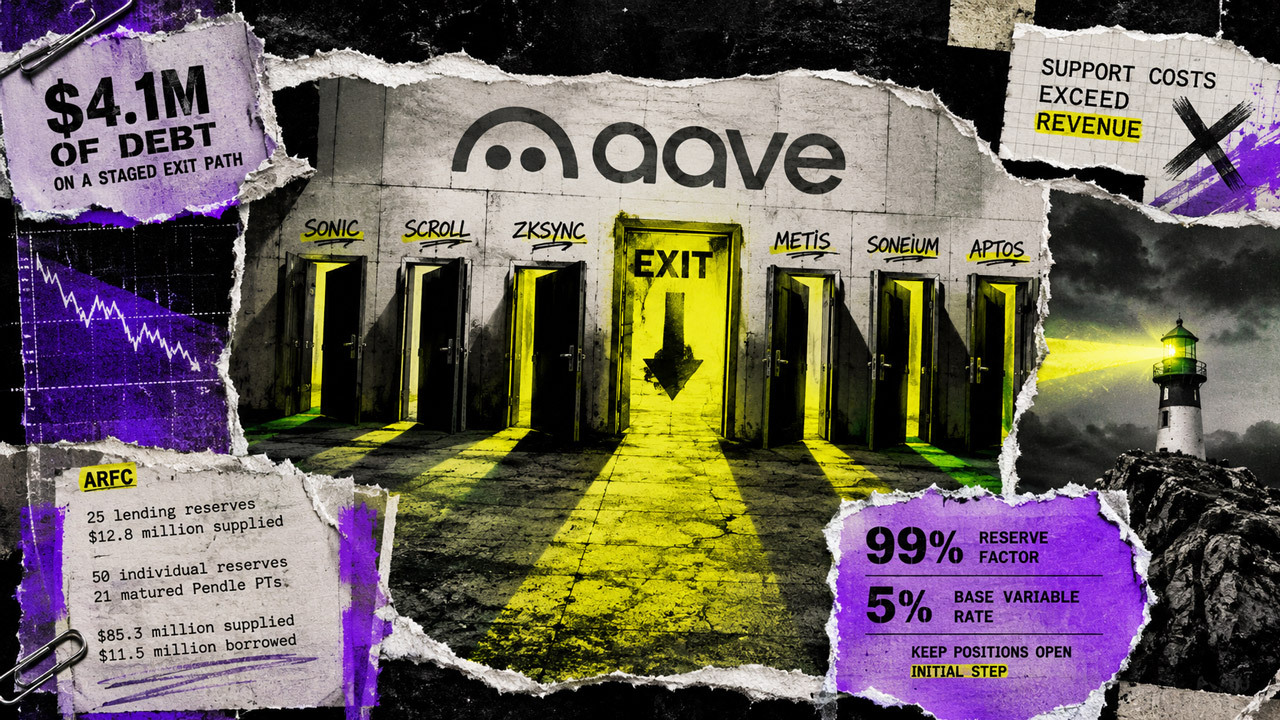
Why DeFi giant Aave is pulling the plug on six hyped blockchains making less than $5,000 a quarter
LlamaRisk would freeze new activity, redirect nearly all interest revenue to the treasury, and reserve stronger unwind levers for later.

Aave weighs closing 6 V3 blockchain markets, offboarding 50 low-use reserves
DeFi risk management service LlamaRisk recommended that Aave wind down every reserve on Sonic, Scroll, zkSync, Metis, Soneium and Aptos, but action against most of those instances was already taken.
Aave Founder Stani Kulechov Backs $98M Market Cleanup
Aave is preparing to wind down deployments on six blockchains and remove dozens of lightly used asset markets. The overhaul affects $98.1 million in deposits as the lending protocol narrows its focus to larger, more productive markets.

Why Aave's $98M cleanup signals a shift from ‘deploy everywhere' DeFi
Will Aave risk approach make other network become "ghost chains"?

Aave to exit Sonic, Scroll, Aptos, and three other blockchain markets affecting $98 million in supplied assets
Aave is moving to deprecate 50 low adoption reserves and wind down six deployments covering $98.1 million in supply and $15.6 million in debt. Aave to exit Sonic, Scroll, Aptos, and three other blockchain markets affecting $98 million in supplied assets.

The economics behind Aave proposal to ditch 6 chains that earn loose change in revenue
A governance proposal would shut deployments on Sonic, Scroll, zkSync, Metis, Soneium and Aptos, and retire 50 asset markets elsewhere. Deposits on some have fallen more than 90%.

Aave moves to wind down Scroll, zkSync and Aptos in reserve cull
Aave's founder Stani Kulechov named Scroll, zkSync and Aptos among the smaller deployments that the project plans to fully retire in part of a sweeping proposal to deprecate another 50 low-adoption asset reserves in a governance push announced on Thursday.


