





Bitcoin

The Bank of Japan Just Triggered $635 Million in Bitcoin ETF Outflows in a Single Day: Is the Rally Over?
Bitcoin ETFs See $635M Outflow as BOJ Triggers Liquidations
Clarity Act markup leaves bitcoin unstirred
The week's main event for digital assets, the U.S. Clarity Act markup, is due later today. The crypto market, led by bitcoin, seems to be treating it as a non-event.

Bitcoin : The rally could stop abruptly, according to CryptoQuant
Bitcoin returns to a dangerous zone. After several weeks of rebound, CryptoQuant estimates that the market could flip if the current resistance holds strong.

The S&P 500 hitting another all-time high just exposed Bitcoin's real problem
Traders have been treating Bitcoin as a high-beta proxy for the same risk appetite driving Nvidia and the Mag-7, one that should move with equities on green days. Instead, Bitcoin lost its $80,000 support and registered an intraday low of $78,759.
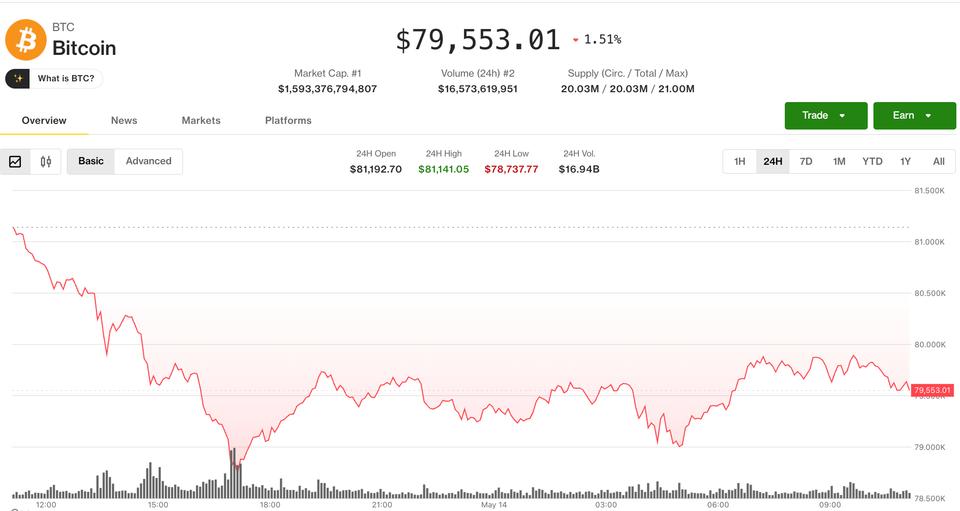
Bitcoin stuck below $80,000 as leveraged longs unwind, altcoins slide
Crypto markets weakened as inflation fears hit risk assets, triggering long liquidations, negative derivatives flows and renewed pressure on altcoins.
Bitcoin Crash Wipes Out $109.7M in Long Positions as Outflows Dry Up and Shorts Dominate
On-chain weakness, aggressive short bets, and inflation data collided to spark Bitcoin's brutal mid-May selloff.

Bitcoin Slips Below $80,000 as Spot ETFs Bleed $635 Million in a Day
Bitcoin dropped to roughly $79,400 after spot ETFs lost $635 million Wednesday, the largest single-day outflow since January, even as long-term holders absorbed a record 4 million BTC.

While Everyone Focuses On Bitcoin And Ethereum, This Crypto Could 'Kickstart A New Bull Rally,' Says Analyst
A leading cryptocurrency analyst flagged a major bullish signal early Thursday, potentially fueling Cardano's (CRYPTO: ADA) next rally. Will ADA Hit $0.42?

Bitcoin price slips below $80K as ETFs hit 4-month high outflows
U.S.-listed spot Bitcoin ETFs recorded their largest single-day outflows in four months on Wednesday as rising inflation concerns and weakening risk appetite pressured crypto markets. According to data from SoSoValue, the 12 spot Bitcoin ETFs in the U.S.

The Real Story Behind AI Recovering a 5 BTC Crypto Wallet
The story of a user who managed to recover 5 Bitcoin tokens worth around $400,000 after 11 years without access to them has attracted huge attention on social media in recent days.

Bitcoin's $78K trap: Why a minor BTC dip can revive short-term holder panic
Bitcoin's short-term holder loss pressure, combined with a decreased supply of young coins, can help ease selling pressure.

JPMorgan's $30 billion Strategy call exposes Bitcoin's new market fault line
A May 7 JPMorgan client note estimated that Strategy could buy roughly $30 billion in Bitcoin in 2026 if Michael Saylor's company maintains its current purchasing pace. That figure positions Strategy alongside spot ETF flows and miner supply as a structural force in Bitcoin's demand architecture.




