





Bitcoin

Bitcoin Price Prediction: BTC Falls Below $81K Amid Liquidations
Bitcoin briefly drops below $81K as $771M in crypto liquidations hits traders. Analysts watch $80K support ahead of US inflation data.

BlackRock-Linked Wallet Sends $203 Million in Bitcoin, Ether
The transfer to Coinbase Prime included 860.393 Bitcoin worth $71.54 million and 52,488 Ether valued at $131 million.

BlackRock-Linked ETF Wallets Move $202.54 Million in BTC, Ether
The transfer included 860.393 BTC worth about $71.54 million and 52,488 ETH valued at roughly $131 million.

Strive Adds 3,311 BTC in Another Massive Bitcoin Purchase
The company has completed another subtantial BTC purchase, extending its accumulation streak.

Blackrock Drives $150M Bitcoin, Ether ETF Selling
U.S. crypto ETFs opened the week under renewed pressure, with bitcoin funds losing $65.40 million and ether ETFs extending their outflow streak to 10 consecutive sessions.

Global liquidity radar: Exchanges add 1,799 BTC as Asia volume rises 219% and US jumps 562%
Major exchanges recorded a 1,799 BTC daily net inflow, while weekly and monthly balances stayed negative. Binance BTCUSDT volume rose 219% in Asia and 561.6% in the US session.

Bitcoin's Once-in-4-Years Signal: Dynamic Rainbow and 200WMA Sync for Buying
While the attention of the general public has shifted from Bitcoin, drifting in a sideways range, to more volatile assets, its long-term metrics have completed the transition into a phase of a deep cyclical bottom.

Bitcoin Rebounds Then Slips as Korean AI Selloff Hits Markets
Bitcoin fell below $81,000 before recovering above $84,000, while crypto-futures liquidations reached about $814 million over 24 hours.

Bitcoin Whale Moves $378M After Six-Year Hold
A Bitcoin whale moved 4,582 BTC worth $377.6 million to five addresses after holding since March 2020, when the balance was worth $40.8 million. Four wallets received 1,000 BTC each and a fifth 582 BTC, but none had moved the coins or been identified as exchange deposits. The wallet made a 0.

Bitcoin and Ethereum ETF Outflows Surge to $151M With Uptober Rally Under Pressure
ETF Outflows: Bitcoin and Ethereum ETFs recorded combined net outflows of $150.8 million on Oct. 12. BTC funds lost $65.4 million, while Ethereum products saw $85.4 million leave the sector. IBIT Concentration: BlackRock's IBIT accounted for the full $65.4 million in withdrawals from BTC ETFs.
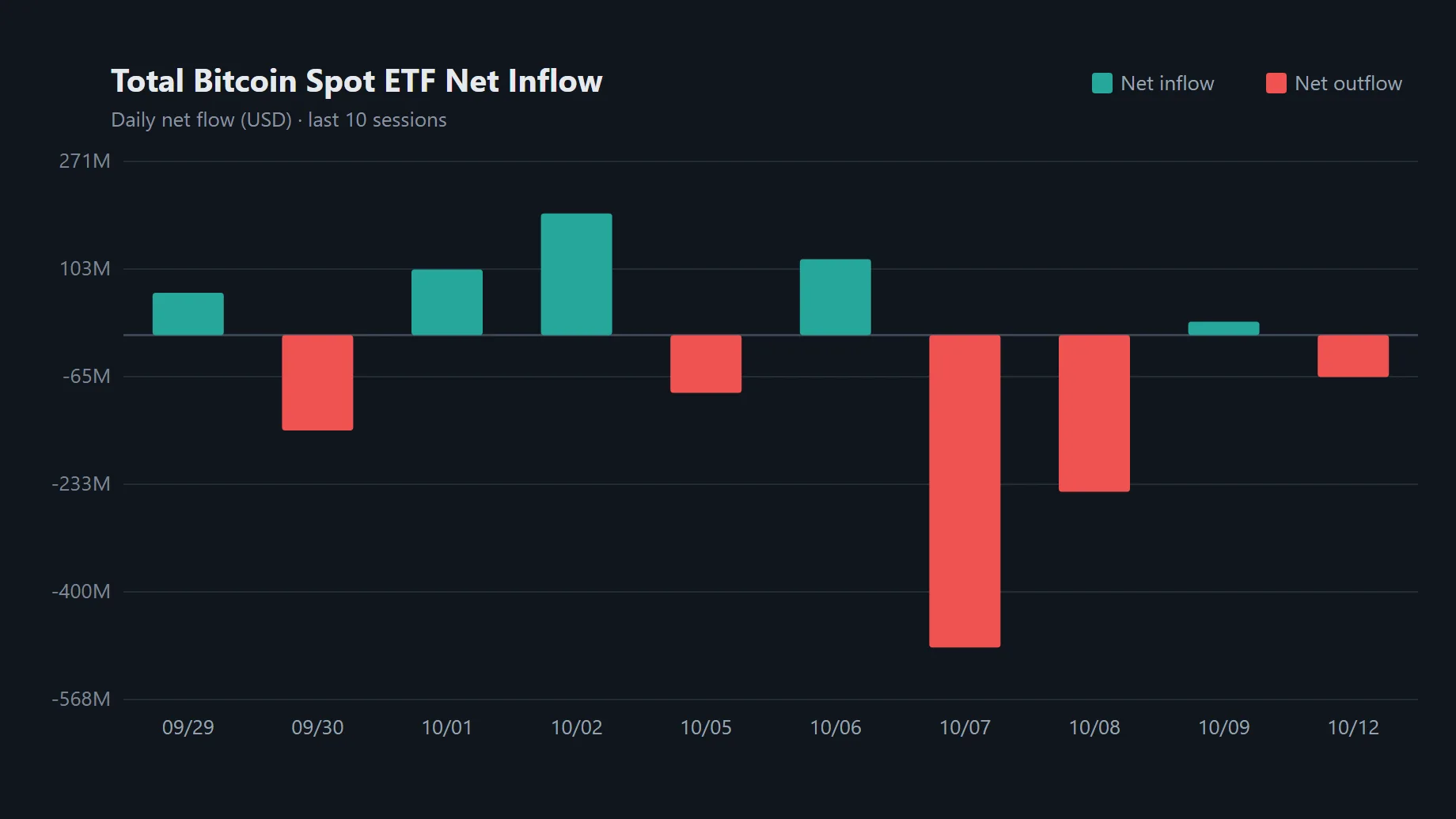
Spot Bitcoin ETF net assets reach $106.06 billion as $65.4 million exits in a day
U.S. spot Bitcoin ETFs returned to daily net outflows, led by a $65.4 million exit from BlackRock's IBIT. Total net assets stood at $106.06 billion.

Best Bitcoin staking platforms in 2026: BTC yield compared
Stacks, Babylon and Core are among the best Bitcoin staking platforms in 2026 for holders who want to earn rewards while keeping native BTC on Bitcoin Layer 1, although their reward structures and risks differ considerably.




