





Ethereum

Ethereum price flips key resistance, prepares for test of $1,850
Ethereum has reclaimed a key resistance zone after bouncing from $1,704, with improving macro sentiment, institutional accumulation, and a technical breakout putting the $1,850 level back into focus. According to data from crypto.

After a $7.5 Million Loss, Can Ethereum Finally Fix MEV?
The operator behind Jaredfromsubway.eth, one of Ethereum's most prolific automated trading bots, offered a 50% white hat bounty on June 22 after a hacker drained more than $7.5 million from the bot's wallet using a carefully constructed on-chain honeypot.

ETH stakers could see rewards cut as Ethereum fights to fund its future
Ethereum core contributors are debating a structural overhaul that could redirect Ethereum staking rewards toward ecosystem development. The protocol-level proposal seeks to solve a persistent coordination failure of funding public goods within the broader Ethereum ecosystem.

Ethereum validators could redirect 10% of staking rewards to ecosystem projects
Redirecting staking rewards to ecosystem projects could democratize funding decisions but risks cartelization and governance challenges. Ethereum validators could redirect 10% of staking rewards to ecosystem projects.

Ethereum Price Prediction: The notorious jaredfromsubway.eth Drained, Vitalik Buterin was a Victim, and The Quest to Make ETH Saver and Faster
Ethereum price is holding, while the network's MEV story just escalated the prediction from abstract protocol debate to an embarrassment.

Ethereum ‘tax' debate erupts over proposal to redirect portion of staking rewards to ecosystem funding
A post on the Ethereum Research forum proposes letting validators vote to redirect up to 10% of staking rewards to fund public goods.

Ethereum staking proposal could send rewards to developers
Ethereum validators may redirect up to 10% of staking rewards to public goods under a new proposal, fueling new funding and control debates.

Bitmine announces BMNP dividend as Ethereum treasury tops 5.6 million ETH
Bitmine Immersion Technologies announced that its board of directors approved a cash dividend of $0.1056 per share for holders of its 9.50% Series A Perpetual Preferred Stock, traded on the New York Stock Exchange under the ticker BMNP.

Ethereum whale shorts $72.4mln at $1,735 – What happens next?
ETH remains at a key inflection point as buyers defend support against growing downside bets.

Ethereum (ETH) Holds Above $1,700: Critical Support Zone Analysis
After half a decade of market turbulence, Ethereum finds itself in a remarkable position: essentially unchanged from its March 2021 valuation. This reality has become a focal point for market participants monitoring the critical $1,700 price region.

Ethereum Layer 2 Taiko halts block production following exploit; urges users to withdraw funds
Onchain security firm Blockaid said the root cause of the exploit could be a flaw in Taiko bridge's source-signal proof validation.
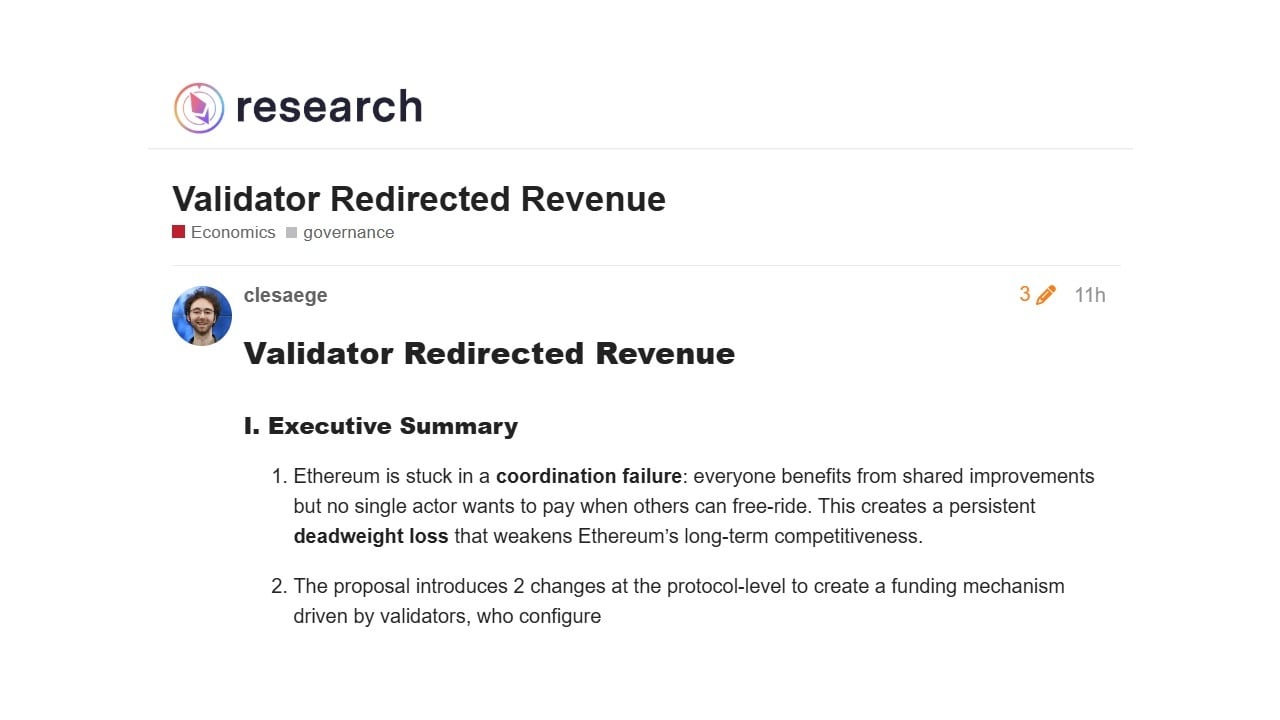
Ethereum Infrastructure Funding: Kleros Founder Proposes Protocol-Level Validator Redirect Rate
A proposal that seeks to implement a semi-voluntary redirect rate to subsidize the creation and operation of shared infrastructure by validators. If the majority of validators agree, the rate becomes mandatory for all, and they can choose which organization gets part or all of these funds.




