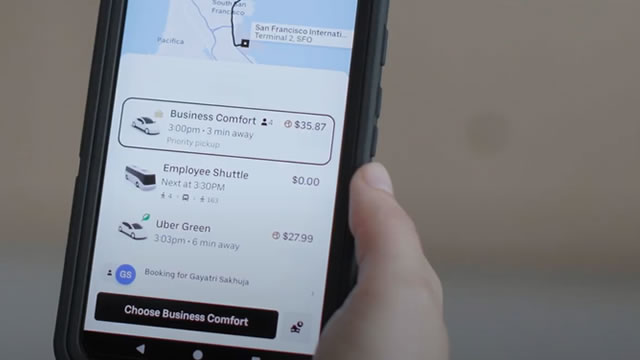
Uber's autonomous taxi infrastructure relies on its partnership with Aurora. This strategic investment could improve Uber's operating margins long term, compared to Tesla and Waymo. In 10+ years, autonomous vehicles may dominate, with Uber's fleet primarily autonomous. This shift should lower taxi prices and attract more customers, significantly benefiting Uber financially. Despite being overvalued, Uber's stock sentiment should rise in the next 10 years as autonomy advances. Investing now could yield long-term rewards, despite potential short-to-medium-term volatility.
Uber (UBER) has been one of the stocks most watched by Zacks.com users lately. So, it is worth exploring what lies ahead for the stock.
A new complaint asks the Federal Trade Commission to investigate fees that Uber and DoorDash added to customer orders in Seattle following the implementation of a minimum wage law earlier this year.
Billionaire hedge fund manager Bill Ackman said he confronted the CEO of Uber after his cab driver accused the ride-sharing app of not allowing him to keep tips.
Uber and Lyft drivers in Minnesota will see higher pay thanks to a deal between the state and the country's two largest ride-hailing companies. The upshot: a new law that gives some protections to drivers while placing limits on state government.
Uber operates ride-hailing, food delivery, and commercial freight platforms. Uber's businesses could benefit from autonomous vehicles, because they potentially eliminate its single largest cost.
ST. PAUL, Minn. — Ride-hailing companies Uber and Lyft said Monday they will keep operating in Minnesota now that state lawmakers have passed a measure that will increase driver pay, but at a lower rate than approved by Minneapolis officials earlier this year.
Nearshoring to continue boosting cross-border trucking in 2024 With ongoing economic tensions between the United States and China, companies looking to relocate parts or all of their supply chains continue to look to Mexico, according to data compiled by Uber Freight. The managed transportation and freight technology provider recently released its "Q2 Market Update & Outlook Report" which discusses the biggest economic trends impacting supply chains. The report sees continued resilience in cross-border trade between the U.S. and Mexico, boosted by nearshoring. "The nearshoring continues to bring new companies to Mexico" Ben Enriquez, Uber Freight's head of Mexico logistics and customs, told FreightWaves. "What we're seeing right now is that there are a lot of companies that are still being established in Mexico. Many companies that last year confirmed that they were going to come to Mexico and establish themselves are settling in, and they are building factories, they are building warehouses." According to Mexico's secretary of the economy (SE), there were 378 foreign direct investment (FDI) announcements last year, totaling over $6.4 billion. Private sector businesses from the U.S. were the top investors in Mexico, accounting for 38% of FDI. China was ranked second at 12%, followed by Denmark (9%), Australia (7%) and South Korea (6%). Mexico hit a new record for FDI in the first quarter of 2024, increasing 9% year over year to $20.3 billion, according to SE. Enriquez said while nearshoring continues to flourish in Mexico, many factories and facilities are still under construction, which could play a large role in cross-border capacity down the road. "Now, we have not seen the full effect of nearshoring, because there are many companies that are in the process of expanding or in the process of opening new facilities" Enriquez said. "That means that they have to get the land, build and hire people, and bring the machinery. It's a two-to-three-year process. In the U.S., commercial transportation is soft. But we're starting to see new customers that are shipping to the U.S. We're going to continue seeing that." Last year, Mexico replaced China as the top U.S. trading partner. Trade between the U.S. and Mexico totaled $798 billion in 2023. In the first quarter of 2024, trade between Mexico and the U.S. totaled $200.1 billion, a 1.7% year-over-year increase. Enriquez said while Uber Freight expects to see more exports from Mexico to the U.S. this year, headwinds to cross-border freight movements include driver shortages in Mexico, as well as continued cargo theft across the country's roadways. "Historically, Mexico did not have driver shortages, but three or four years ago, the shortage started and was even more pronounced because many of the domestic Mexico drivers started to get their B-1 visa permits" Enriquez said. "They started driving for B-1 carriers, and the B-1 carriers started ramping up operations at U.S.-Mexico border crossing points. Many of the drivers that were driving in from Mexico are now driving for U.S. companies." Mexico's trucking industry currently has as many as 56,000 unfilled driver positions, a 9% year-over-year increase compared to the same period in 2023, according to a recent report from the International Road Transport Union. "Mexican trucking companies are losing drivers to the U.S. because they are getting paid three to four times more than what they get paid for domestic driving" Enriquez said. "Mexican carriers have had to increase salaries to try to keep their drivers. We continue to see that as a problem. Some states like Nuevo Leon and cities like Monterrey that in the past didn't have those issues, now they have them. We talked to our carrier partners, and we know that they're struggling with drivers." Cargo security also continues to be a major issue for the freight transport industry in Mexico. In April, Mexico averaged about five cargo truck thefts per day, totaling 153 incidents across the country's roadways, according to the National Association of Vehicle Tracking and Protection Companies (ANERPV). Tractor-trailer thefts in April increased 7.7% from the same month last year. ANERPV reported a total of 546 tractor-trailer thefts from January through April, a 5% year-over-year increase. Enriquez noted that while cargo security is a problem in the U.S. and Mexico, the key distinction is the use of violence. "The big difference between the U.S. and Mexico is that in the U.S. there's identity theft; it's more technological" Enriquez said. "In Mexico, they hijack the trucks. They are stopped by two or three cars by people with guns. They jam the GPS, they take the truck. We're seeing some gangs that are dedicated to getting some specific goods from factories and reselling them." To secure cross-border capacity as demand increases over the next several quarters, Uber Freight recommends shippers form long-term commitments with carriers. "I would say there is still capacity available and there are good carriers out there that can provide capacity service" Enriquez said. "This is a good time to negotiate long-term rates that are decent rates for carriers. I have always recommended diversified modes of transportation, like intermodal." Mexico's trucking industry currently has as many as 56,000 unfilled driver positions, according to the International Road Transport Union. (Photo - Jim Allen/FreightWaves) Careismatic Brands to close two Dallas distribution hubs, lay off 404 employees Careismatic Brands is permanently closing two distribution centers in Dallas and laying off 404 workers, according to a filing with the Texas Workforce Commission. The company cited "changing business needs" for the closure of the two facilities. The distribution hub's closure comes just over a year after the medical apparel seller consolidated its shipping operations in Dallas. The facility was intended to centralize the manufacturer's distribution in the U.S., Mexico, parts of Canada and Latin America. California-based Careismatic Brands is one of the largest makers of medical apparel and school uniforms and employs over 700 people in six countries. ITS Logistics to open office in Fort Worth ITS Logistics will open an office in Fort Worth, Texas, for its newly released ContainerAI container management and visibility platform. The Fort Worth City Council recently voted to approve a three-year grant of up to $847,500 to ITS Logistics, according to Forth Worth Report. In return for the grant, ITS Logistics is required to lease at least 15,000 square feet of office space by June 30 and invest $1 million in the facility. The company also must create between 250 and 339 full-time jobs by Dec. 31, 2027. ContainerAI is an AI-driven offering aimed at providing network engineering, specialized industrial services, drayage, intermodal, cross dock and container management solutions to customers in every major port and rail market across North America. Reno, Nevada-based ITS Logistics is a 3PL providing supply chain solutions across the U.S. Aztema begins construction of $240M tire plant in Mexico Aztema Rubber and Tire Manufacturing recently began construction of a $240 million tire manufacturing facility in the Mexican city of Irapuato, according to Cluster Industrial. The factory will create a total of 1,400 direct and indirect jobs. The facility will have an annual production capacity of 6 million semi-steel radial tires. Construction is scheduled to be completed by the end of the year. Aztema is a joint venture between China-based Sailun Tire and Mexico-based Tire Direct. The joint venture was announced in December. Sailun Tire is based in Qingdao, China, and manufactures tires for passenger and commercial vehicles. Tire Direct is based in Leon, Mexico. The company is one of Mexico's largest tire distributors. The post Borderlands Mexico: Nearshoring to continue boosting cross-border trucking in 2024 appeared first on FreightWaves.
Minnesota lawmakers reached an agreement Sunday on a bill that is designed to raise the pay rate for Uber and Lyft drivers working in the state.
ST. PAUL, Minn. — A plan to boost pay for Uber UBER, -0.58% and Lyft LYFT, -1.95% drivers in Minnesota that lawmakers believe would prevent the companies from leaving the market advanced in the state Legislature on Sunday, hours before the deadline for lawmakers to pass bills before they adjourn.
Uber continues to report strong growth in terms of users and gross bookings. Investors shouldn't expect the rapid gains to continue forever, especially as Uber's expansion runway naturally shrinks over time.
Uber's user base, as well as gross bookings, continue rising at a double-digit pace. This company has now posted four straight quarters of positive operating income.