





Aave
Dragonfly's Haseeb Qureshi: Aave Has the Capital to Absorb Bad Debt Amid DeFi Risk Concerns
Dragonfly Managing Partner Says DeFi Learns From Failures and Grows Stronger With Every Crisis

Curve Founder Asks “Are We an Industry of Clowns?” After $750M in DeFi Hacks
Imagine your grandmother puts her life savings into Aave – one of the biggest DeFi protocols on the planet. Then on Monday morning she tries to withdraw and cannot. Not because Aave was hacked. Aave says it is operating as intended. Not because rsETH was hacked. rsETH says all code is safe.

Aave Liquidity Crisis: The 'Slow Burn' Trap Freezing Millions in USDC and USDT
Aave faces a liquidity trap as USDC/USDT utilization hits 100%. Here's how the 'Slow Burn' mechanism freezes lender withdrawals and benefits borrowers.

Onchain Analysts Flag Justin Sun-Linked Wallet's 274 Million USDT Exit From Aave Minutes After rsETH Freeze
A wallet linked to Justin Sun by onchain analysts withdrew 274 million USDT from Aave just 21 minutes after the protocol froze its rsETH markets on April 18, following the KelpDAO exploit. Key Takeaways: A wallet linked to Justin Sun pulled 274 million USDT from Aave 21 minutes after the rsETH market was frozen.

AAVE Price Plummets By 26%: $9 Billion Net Outflows Traced To Kelp DAO Hack
A $292 million hack tied to restaking protocol Kelp DAO has rippled through decentralized finance (DeFi) lending and market confidence far beyond the original incident, with Aave emerging as one of the hardest-hit examples. Over the weekend, Aave's native token (AAVE) fell by about 26%, while the protocol also saw a sharp decline in total value locked (TVL) and continued outflows that intensified the downturn.

A $292M Hack Created $200M In Bad Debt On Aave: Here Is What That Means For Users
Aave has shed more than 23% of its value since Friday, and the protocol that bills itself as DeFi's most trusted lender is now managing the fallout from one of the most disruptive exploits in its history — even though its own code was never touched. Related Reading: XRP Just Settled $291 Million On-Chain, Almost Nothing Hit Binance: Find Out What's Happening The attack unfolded through a bridge vulnerability rather than a flaw in Aave itself.

Incident Report: Llamarisk, Aave Service Providers Detail Kelp rsETH Hack Across Ethereum and Arbitrum Markets
An incident report published by Llamarisk to the Aave forum explains that a bridge exploit targeting KelpDAO's Layerzero V2 rsETH route on Saturday allowed an attacker to extract 116,500 rsETH from Ethereum's OFT adapter without burning any tokens on the source chain.

Aave and Kelp are working on bailout options as losses keep piling up
Aave is currently locked in a tight situation in the KelpDAO hack that Cryptopolitan reported on April 18, where an attacker drained 116,500 rsETH, worth about $292 million, from Kelp's cross-chain bridge. Sources who have been granted anonymity reached out to Cryptopolitan and described Aave as being stuck between bad options and pressure to act.

DefiLlama founder rejects claims Aave TVL is inflated by looping trades
DefiLlama founder 0xngmi says Aave's TVL isn't being “pumped” by circular borrowing, arguing the platform's metrics already strip out borrowed assets and loops.
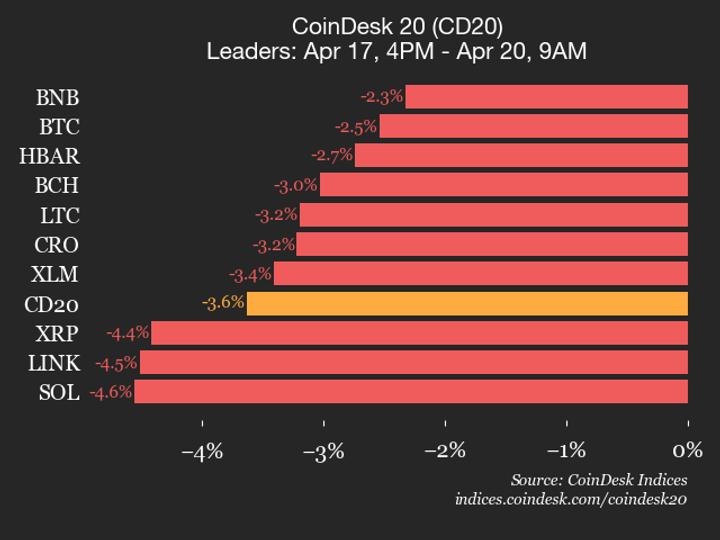
CoinDesk 20 performance update: AAVE price plummets 22.9% over weekend
Bitcoin (BTC) price dropped 2.5% and BNB Token (BNB) fell 2.3% from Friday.
Aave Borrowing Jumps $300M, Exposing Liquidity Stress After KelpDAO Exploit
A KelpDAO exploit triggered a liquidity crisis on Aave, where roughly $300 million in loans were taken out within 24 hours. The attacker deposited 116,500 unbacked rsETH into Aave to withdraw real assets, generating bad debt within the protocol.

LayerZero says Kelp setup caused exploit, as Aave loss questions mount
LayerZero said that Kelp's DVN setup caused the $290 million exploit, as investors questioned which protocol would step up to cover the shortfall.




